If your child has dyslexia and struggles with handwriting, you've probably already tried the obvious things. More practice. Careful copying. Slower writing. And you've probably noticed that none of it produced the consistent improvement you were hoping for. That's not a failure of effort — on your part or your child's. It's a method problem, and it's a very specific one.
Handwriting support for dyslexic children is fundamentally different from general handwriting improvement. It requires understanding why dyslexia affects writing, not just that it does. It requires methods that work with the way a dyslexic brain encodes movement — not methods designed for the majority of learners that happen to be rolled out universally. And it requires an atmosphere where the child feels capable of improving, rather than permanently broken at something their classmates find easy.
This guide is written for parents and teachers who want practical, evidence-informed strategies — not vague reassurances. Every recommendation here has a reason behind it. Understanding the reason will help you adapt these strategies to your specific child, which is ultimately what works best.
- Why Dyslexia Affects Handwriting — The Real Explanation
- Myths vs Facts — What Parents and Teachers Get Wrong
- Step 1 — Fix Grip and Posture Before Anything Else
- Step 2 — The Tools That Actually Make a Difference
- Step 3 — The Multi-Sensory Approach (Why It Works for Dyslexia Specifically)
- Step 4 — Teach Letters in Groups, Not the Alphabet Order
- Step 5 — Tackling Letter Reversals (b/d, p/q and Others)
- Step 6 — Building a Daily Practice Routine That Sticks
- Should Dyslexic Children Learn Cursive?
- The Emotional Side — Confidence, Frustration, and Progress
- What to Realistically Expect — A Progress Timeline
- Frequently Asked Questions
Why Dyslexia Affects Handwriting — The Real Explanation
Most people think of dyslexia as a reading problem. And while reading difficulties are often the most visible symptom, dyslexia is more accurately described as a difference in how the brain processes language — and that affects writing just as much as reading, often in ways that don't get discussed clearly.
Here's what's actually happening when a dyslexic child sits down to write. First, there's the phonological processing challenge — the brain's ability to connect sounds to symbols. When a child is writing, they're not just copying shapes. They're translating sounds into letters, and for a dyslexic child that translation is slower and requires more conscious effort. That extra cognitive load leaves less mental space for attending to the physical act of writing — grip, pressure, letter formation, spacing.
Second, many children with dyslexia also experience difficulties with motor planning — the brain's ability to automatically sequence the physical movements that produce a letter. For most children, after a certain amount of practice, the movement for writing the letter "a" becomes almost unconscious. For a dyslexic child, that automaticity often develops more slowly, meaning the child has to consciously think about the physical movement for longer. Writing becomes tiring much faster because it takes more deliberate effort.
Third, there's the problem of letter direction and orientation. The brain typically builds strong automatic memories for the direction letters face. Dyslexic brains often have weaker directional memory for symbols — which is why letter reversals like b/d and p/q are so common and so persistent. It's not carelessness. The visual memories for those letter forms are genuinely less stable.
When a dyslexic child writes a sentence, their brain is managing spelling, letter formation, motor sequencing, spacing, and meaning all at once — with each of those processes demanding more conscious attention than it does for a non-dyslexic child. By the time they're halfway down a page, they're genuinely fatigued in a way that has nothing to do with laziness or effort. Understanding this will change how you structure support — because long sessions aren't just unhelpful, they're actually counterproductive.
Myths vs Facts — What Parents and Teachers Get Wrong
Before we get into strategies, it's worth clearing up a few things that well-meaning adults get wrong — because some very common approaches to helping dyslexic children with handwriting are actively unhelpful.
| ❌ Common Myth | ✅ What's Actually True |
|---|---|
| "He just needs to slow down and be more careful." | Slowing down alone doesn't help if the underlying letter formation is wrong. Careful slow repetition of a mistake just reinforces the mistake. The method needs to change, not just the speed. |
| "More practice will fix it — she just needs to do it more." | Practice without the right technique and multi-sensory support produces minimal improvement in dyslexic children. Volume of practice matters far less than quality and method. |
| "He sees letters backwards — he needs his eyes tested." | Letter reversals in dyslexia are a language-processing issue, not a visual acuity issue. Standard eye tests don't detect this, and glasses won't fix it. The problem is in the brain's symbol-direction memory, not the eyes. |
| "She'll grow out of it." | Some minor reversals resolve naturally. Significant handwriting difficulties associated with dyslexia don't self-correct without targeted intervention. Earlier support produces better outcomes. |
| "Typing is the answer — let him type instead." | Typing is a valuable accommodation, but handwriting skills remain important for exams, everyday life, and cognitive development. Research also suggests handwriting supports reading and spelling development in ways typing doesn't fully replicate. |
| "She needs a longer handwriting session to catch up." | Longer sessions are worse for dyslexic children, not better. Cognitive fatigue sets in quickly and causes quality to deteriorate. Ten focused minutes beats forty unfocused ones every time. |
Step 1 — Fix Grip and Posture Before Anything Else
Children with dyslexia are significantly more likely to grip their pencil or pen tightly — often extremely tightly. This isn't coincidence. When a child is cognitively overloaded, physical tension increases. The tight grip is a stress response, and it compounds the writing difficulty because tense fingers produce cramped, shaky letters that tire the hand within minutes.
Sorting grip out before you do anything else isn't optional. An incorrect, tense grip will limit the results of every other strategy you try.
The Correct Grip for Young Dyslexic Writers
The tripod grip — pencil resting between thumb and index finger, supported by the middle finger, held about 2–3 centimetres from the tip — is the goal. For children who struggle to achieve or maintain this, triangular pencils and pencil grip aids are genuinely useful (not just gimmicks). The triangular shape physically positions the fingers correctly and makes the wrong grip less comfortable.
Most importantly: the grip should be loose. You should be able to slide the pencil out with a gentle pull. If a child's fingers are whitening or the pencil is making deep indentations in the paper, the grip is far too tight. Teach the child to shake their hand loose before every writing session, and to check grip tension every few minutes — an easy cue is placing a small sticker on the back of the hand as a reminder to check.
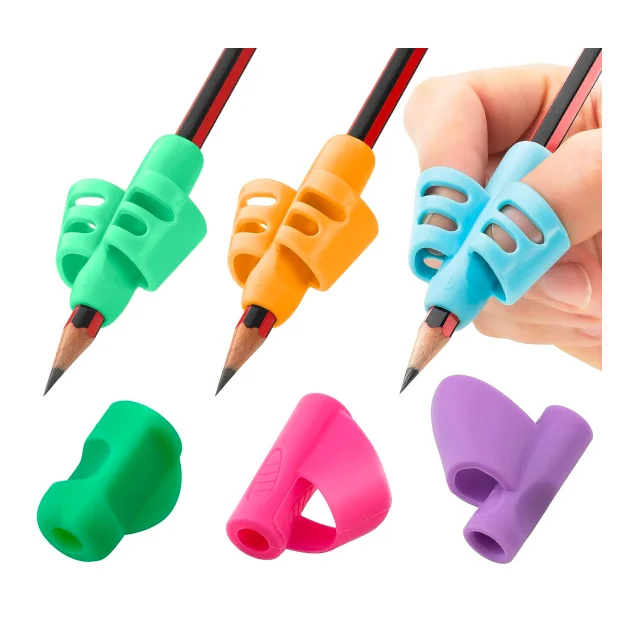
Triangular pencils and grip aids physically guide the hand to the correct position — removing one layer of conscious effort for an already cognitively busy child.
Posture and Paper Positioning
Seat the child at a table where their feet can rest flat on the floor and their forearm can rest comfortably on the desk. Writing with a floating, unsupported arm is exhausting and produces inconsistent results. The paper should be angled — around 15–20 degrees to the left for right-handed children, to the right for left-handed children. This natural angle aligns the wrist movement with the direction of writing, reducing strain considerably.
A slant board — a wedge-shaped writing surface that tilts the paper toward the child — is one of the most underrated tools for dyslexic children who fatigue quickly during writing. It naturally improves wrist position, reduces the effort needed to see the page, and often produces an immediate improvement in letter quality. They're inexpensive and available online; several dyslexia organisations also recommend them specifically.
Step 2 — The Tools That Actually Make a Difference
The right tools reduce friction. For a dyslexic child who already finds writing harder than their peers, equipment that requires extra pressure or produces scratchy, inconsistent lines adds frustration on top of difficulty. Here's what actually helps:
| Tool | Best Choice | Why It Helps for Dyslexia | Avoid |
|---|---|---|---|
| Pencil | Triangular HB pencil, or triangular grip on a standard pencil | Physically guides the grip without instruction; HB is soft enough not to require pressure; mistakes can be erased, which reduces anxiety | Very hard pencils (require more pressure); round pencils (don't guide grip) |
| Pen (when ready) | 0.7mm gel pen or rollerball | Flows without pressure, produces confident-looking lines which builds motivation, no need to press hard | Scratchy ballpoints (require pressure), fine-liners (too thin, require precision) |
| Paper | Wide-ruled lined paper with coloured baseline (green or blue) | Coloured baseline gives a strong visual anchor for letter sitting; reduces baseline-drift without the child having to think about it | Blank paper (no reference points), graph paper (too visually busy) |
| Paper type | Slightly textured or cream-coloured paper | Reduces glare (important for children with visual processing sensitivities common alongside dyslexia); slight texture gives tactile feedback | Glossy or very bright white paper (can cause visual discomfort) |
| Writing surface | Slant board (15–20° angle) | Improves wrist position, reduces fatigue, often improves letter quality immediately | Flat hard tables only (no cushioning, can increase pressure) |
| Multi-sensory tools | Sand tray, textured letter cards, whiteboard and marker | Allows letter formation practice without paper — critical for the multi-sensory approach (covered in Step 3) | Worksheets only — one-dimensional practice without sensory variety |
Get one notebook specifically for handwriting practice. Write the child's name on it and the date they start. This notebook is their evidence of progress — and for a dyslexic child who often feels like they're making no progress at all, being able to physically flip back to their writing from six weeks ago and see the contrast is one of the most powerful motivational tools available.
Step 3 — The Multi-Sensory Approach (Why It Works for Dyslexia Specifically)
This is the single most important concept in this entire guide. If you only take one thing from it, take this: for dyslexic learners, multi-sensory practice dramatically outperforms single-mode practice. That means practising handwriting through touch, movement, sound, and sight — simultaneously — not just through looking at a letter and copying it onto paper.
The reason this works specifically for dyslexia relates to how the dyslexic brain encodes new patterns. When a letter is learned through multiple sensory channels at once, the memory of that letter is stored in more pathways in the brain. This makes it more stable, more retrievable under pressure, and more resistant to the interference that causes reversals and formation inconsistencies.
Every major evidence-based approach to supporting dyslexic writers — Orton-Gillingham, the Barton Reading and Spelling System, the British Dyslexia Association's guidance — places multi-sensory learning at the centre. This is not fringe advice. It's the consensus.
Practical Multi-Sensory Methods for Handwriting
For each new letter: sand tray first → air writing → textured card tracing → whiteboard large-scale → paper. By the time the child writes the letter on paper for the first time, their brain already has the movement pattern stored through four different sensory channels. The paper version is a confirmation, not the first attempt. This sequence typically produces better first-on-paper results in one session than weeks of paper-only practice.
Step 4 — Teach Letters in Groups, Not the Alphabet Order
One of the easiest changes to make — and one of the most overlooked — is teaching letters in groups based on their shared starting stroke, rather than alphabetically. A–B–C–D order makes intuitive sense to adults but it's pedagogically backwards. Letters that share a starting movement should be taught together, because practising one reinforces the others in the group.
For dyslexic children specifically, grouping by formation pattern reduces the cognitive load because the hand gets to practise a familiar starting movement repeatedly rather than constantly switching to something new. The groups below are based on the formation patterns most relevant to print handwriting:
Work through one group over the course of a week before moving to the next. If a child's weakest letters are all in the oval group — which is extremely common, since a, d, g, and q are all frequent reversal candidates — start there and spend two weeks on it rather than rushing to move on.
Step 5 — Tackling Letter Reversals (b/d, p/q and Others)
Letter reversals — particularly b and d — are one of the most distressing aspects of dyslexic handwriting for both children and parents. Let me say something clearly before offering solutions: reversals are not a sign of low intelligence, carelessness, or inadequate practice. They are a specific feature of how some dyslexic brains store directional information about symbols. Telling a child to "pay more attention" will not fix them.
The b/d Confusion — The Most Reliable Solutions
Draw the word "bed" as an image: the b on the left is the headboard (tall stick first, bump on the right), the e is the mattress, the d on the right is the footboard (tall stick last, bump on the left). The word "bed" looks like a bed, and the position of b and d within the word tells you which way each one faces. Once this visual anchor clicks, it tends to stick. Reinforce it by keeping a small "bed" reference card at the child's desk for several months.
Teach b and d with completely different verbal sequences to make them feel physically different, not just visually different. "b — straight line down, then bounce up and around to the right." "d — big curve around, then up tall and back down." If the physical action of writing each letter feels different in the hand, directional confusion reduces because the motor memory distinguishes them even when the visual memory wavers.
This sounds obvious but is frequently ignored. Teaching b and d close together activates the very interference that causes confusion. Space them out: teach b thoroughly until it's fully reliable, then introduce d. In practice, this usually means a gap of one to two weeks between the two letters. The same applies to p and q.
Use the textured card and sand tray methods specifically for the confusable pairs. Have the child trace b with their left hand and d with their right hand — the physical asymmetry of which hand is used adds another channel of distinction. Write each letter very large in the air, emphasising the starting direction. The goal is to make these letters feel as physically different as possible, not just look different.
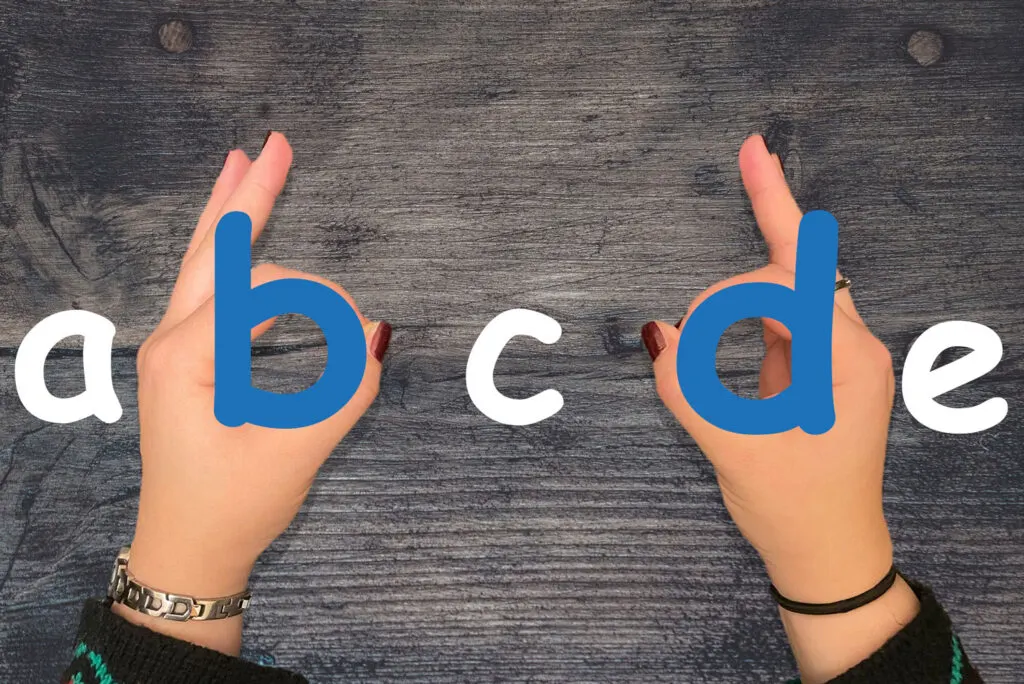
The "bed" anchor is one of the most effective and widely recommended techniques for resolving persistent b/d confusion in dyslexic children.
Step 6 — Building a Daily Practice Routine That Sticks
Consistency is what produces lasting improvement. The method matters, but the habit of daily practice is what actually transforms handwriting over time. The challenge with dyslexic children is that writing is often the thing they least want to do — so the routine needs to be structured around what works emotionally as much as what works pedagogically.
Keep sessions to 10–15 minutes maximum. Below is a weekly schedule designed specifically for dyslexic children, using the multi-sensory approach. Each session is short, has a clear focus, and includes a non-paper element to maintain engagement:
When a child resists or time is short, the sand tray, air writing, and whiteboard sessions are often the first things dropped — leaving only the paper sessions. This is exactly backwards. The multi-sensory, non-paper sessions are what build the motor memory that makes the paper sessions work. If you can only do one thing on a given day, make it the sand tray or air writing rather than a worksheet. The tactile and kinesthetic memory will serve the child longer.
Should Dyslexic Children Learn Cursive?
This surprises a lot of parents: many dyslexia specialists actively recommend introducing cursive writing alongside or after print — not as an alternative, but as an addition. The reason is counterintuitive but backed by a reasonable amount of evidence and widespread clinical experience.
Cursive reduces some of the specific difficulties that make print hard for dyslexic children. When letters are joined in a continuous flow, each word has a unique movement pattern. The child's hand learns to write "cat" as a single flowing action, rather than assembling three separate letters. This reduces the amount of letter-by-letter recall needed, which lowers cognitive load.
More specifically for reversals: in cursive writing, b and d feel and look very different because they join to adjacent letters in different ways. The flowing movement of writing "bed" in cursive makes a b/d reversal physically awkward — the flow of the join doesn't work if the letter is reversed. Many children who persistently reverse letters in print stop doing so in cursive because the movement pattern doesn't allow it.
Cursive is beneficial, but not until print letter formation is reasonably stable. Introducing cursive joins to a child who hasn't yet mastered individual letter forms adds complexity on top of existing difficulty. A good rule of thumb: once the child can write all 26 letters legibly in print, with correct formation sequence and consistent sizing, then begin introducing joins — starting with the easiest: "ai," "an," "in," "ou," "un." If your child is still confusing letter directions in print, cursive isn't the immediate next step.
For a broader look at how handwriting style affects different learners, our article on how to improve your handwriting generally covers the print vs hybrid vs cursive decision in depth.
The Emotional Side — Confidence, Frustration, and Progress
This section exists because you can use every strategy in this guide correctly and still get poor results if the child's emotional relationship with handwriting isn't addressed. Dyslexic children often develop significant anxiety and shame around writing — not because of the handwriting itself, but because of years of experiences where their efforts didn't match other children's results despite working harder.
That shame becomes a barrier. A child who expects to fail at handwriting will tense up before the pencil touches the paper, which worsens grip, which worsens letter formation, which confirms the expectation. It's a self-fulfilling loop.
What Actually Helps — Not Just What Sounds Nice
What to Realistically Expect — A Progress Timeline
Handwriting improvement for dyslexic children is slower than for non-dyslexic peers, and it's less linear. There will be sessions that feel like regression — a letter that seemed fixed suddenly reverses again, or consistency that appeared overnight disappears. This is normal. The new patterns compete with deeply ingrained old ones for a long time before they reliably win. Knowing what to expect prevents the discouragement that causes people to give up too early.
📚 Related Guides You Might Find Useful
✅ Key Takeaways — Dyslexia and Handwriting Support
- Dyslexia affects handwriting through phonological processing challenges, motor planning difficulties, and weak directional memory for letter forms — not through laziness or insufficient effort.
- Multi-sensory practice (sand tray, air writing, textured cards, whiteboard) dramatically outperforms paper-only practice for dyslexic learners.
- Fix grip and posture first — a tense grip compounds every other difficulty and limits the results of all other strategies.
- Teach letters in formation groups, not alphabetical order. Work on one group at a time for one to two weeks.
- Never teach b and d in the same session. Space confusable pairs several weeks apart.
- Sessions should be 10–15 minutes maximum, daily. Short and frequent beats long and occasional for motor skill development.
- End every session on a specific, named success. Emotional relationship with writing is as important as technique.
- Expect first visible improvements in 3–4 weeks, significant consolidation at 8–12 weeks, and sustainable change at 3–6 months.
✍️ Try Structured Handwriting Practice on Handwriting Repeater →