There's a particular kind of low-level worry that most parents of primary-aged children will recognise: you're sitting next to your child while they do their homework, you watch them write something, and a small voice in the back of your head says — is that normal? Should it look like that?
Handwriting is one of those school skills that parents feel oddly uncertain about, partly because the standards aren't widely communicated, and partly because most of us are working from a memory of what our own handwriting looked like at that age — which may or may not have been typical. The result is a lot of unnecessary worry in one direction ("my child's handwriting looks terrible, something must be wrong") and, equally, some missed opportunities in the other ("they seem fine, I'm sure it'll sort itself out").
This guide is for parents of children in Key Stage 1 — Reception through to Year 2, ages four to seven — who want to understand what is actually expected, what's actually typical, and what they can genuinely do to help. It's written plainly, based on the National Curriculum for England, and grounded in what handwriting development actually looks like in real classrooms — not in an idealised version of it.
- What Is KS1 and What Does It Cover?
- What the National Curriculum Actually Says About KS1 Handwriting
- Year 1 Handwriting Expectations — What's Normal?
- Year 2 Handwriting Expectations — What Should It Look Like?
- Letter Families — How Schools Teach Formation Groups
- Grip, Posture, and Paper Position in KS1
- UK Handwriting Schemes — Which One Does Your School Use?
- Common Parent Concerns — What's a Red Flag and What Isn't
- How to Help Your KS1 Child With Handwriting at Home
- Moving Into KS2 — What Changes Next?
- Frequently Asked Questions
What Is KS1 and What Does It Cover?
Key Stage 1 (KS1) refers to Years 1 and 2 of primary school in England, covering children roughly aged five to seven. It follows the Early Years Foundation Stage (EYFS), which includes Reception, and leads into Key Stage 2, which runs from Year 3 to Year 6.
In terms of handwriting specifically, KS1 is the foundation-building phase. This is where children go from the emergent, approximate letter shapes they may have developed in Reception to forming all 26 lower-case letters correctly, consistently, and in the right direction. By the end of Year 2, the goal is a child who can write legibly — meaning another adult can read it without effort — using consistent letter formation and reasonable word spacing.
What KS1 is not is the stage where children should be writing in joined-up or cursive handwriting. That's a KS2 objective. One of the most common things parents get anxious about unnecessarily is that their Year 1 or Year 2 child isn't joining their letters yet. In most schools, it is neither expected nor taught at this stage. The foundation has to come first.
Reception is technically part of the Early Years Foundation Stage (EYFS), not KS1. So when teachers and the National Curriculum talk about KS1 handwriting expectations, they mean Year 1 and Year 2 specifically. If your child is in Reception and their handwriting looks very immature — that is completely expected. The formal KS1 framework kicks in when they move into Year 1.
What the National Curriculum Actually Says About KS1 Handwriting
The National Curriculum for England (2014) is the document that sets out what schools are required to teach. For handwriting in KS1, it sits within the English subject requirements under "Transcription." The language is clear, but many parents have never actually read it — so here's what it says, in plain terms.
Statutory Requirements for KS1 Handwriting
By the end of KS1, pupils are expected to be able to:
The curriculum also includes "non-statutory guidance" — suggestions that are not legally required but are considered best practice. These include practising writing on lined and unlined paper, developing stamina for writing, and beginning to use some of the diagonal and horizontal strokes needed to join letters (though not joining itself — that's KS2).
All state schools in England must follow the National Curriculum. Independent schools are not legally required to, but the overwhelming majority align to it in practice. If your child is at a state school, these requirements are what their teacher is planning towards — and what their Year 2 teacher assessment will reference.
Year 1 Handwriting Expectations — What's Normal?
Year 1 is, in honest terms, a year of huge variability. Two children sitting next to each other in the same classroom, at the same age, receiving identical teaching, can produce handwriting that looks like it belongs to children two or three years apart. This is completely normal at this stage. Fine motor development, language development, and prior experiences with writing all vary enormously between children who are technically the same age.
With that said, here is what a Year 1 child's handwriting should broadly be showing by the end of the year — the kind of progress that would tell a teacher that a child is developing on track:
What is not expected in Year 1: consistent letter sizing, letters all the same height, perfect baseline adherence, neat spacing, or anything approaching joined writing. If your Year 1 child's handwriting looks like it was produced by a much younger child compared to an adult standard — that's because it was. And that's fine.
Frequent and consistent reversal of many letters (not just b/d), inability to hold a pencil at all without significant difficulty, refusal or severe distress when asked to write, or very poor fine motor control that's affecting both writing and other fine motor tasks like fastening buttons or using scissors — these are worth mentioning. They won't necessarily indicate a problem, but they're worth raising early so the teacher can observe and provide additional support if needed.
Year 2 Handwriting Expectations — What Should It Look Like?
Year 2 is where everything from Year 1 is expected to consolidate. The progress between the end of Year 1 and the end of Year 2 should be significant — and it usually is, because these are the years when fine motor development accelerates rapidly for most children. Think of Year 1 as the "learning the moves" phase and Year 2 as the "making them consistent" phase.
By the end of Year 2, the National Curriculum expects that children can demonstrate all of the following:
- Beginning to form lower-case letters correctly
- Attempts capital letters
- Some spacing between words
- Digits 0–9 being practised
- Letters generally recognisable
- Functional pencil grip developing
- All lower-case letters correctly and consistently formed
- All capital letters correctly formed
- Consistent word spacing
- Digits 0–9 correctly formed
- Letters legible to any adult reader
- Pre-joining strokes beginning in some letters
The word "consistently" is doing a lot of work in that Year 2 column. A Year 2 child who can form every letter correctly when working slowly under ideal conditions, but whose letters fall apart when writing at their normal speed, hasn't fully met the Year 2 expectation. The goal is formation that's automatic enough to survive everyday writing — not just special showcase writing.
This is also the year where many schools introduce what the National Curriculum calls "diagonal and horizontal strokes" — the entry and exit strokes that prepare letters for eventual joining. Some schools (particularly those using schemes like Letterjoin or Kinetic Letters) start this in Year 2. Others wait until Year 3. If your child's school introduces these, you may see their letters starting to have small "tails" at the bottom.
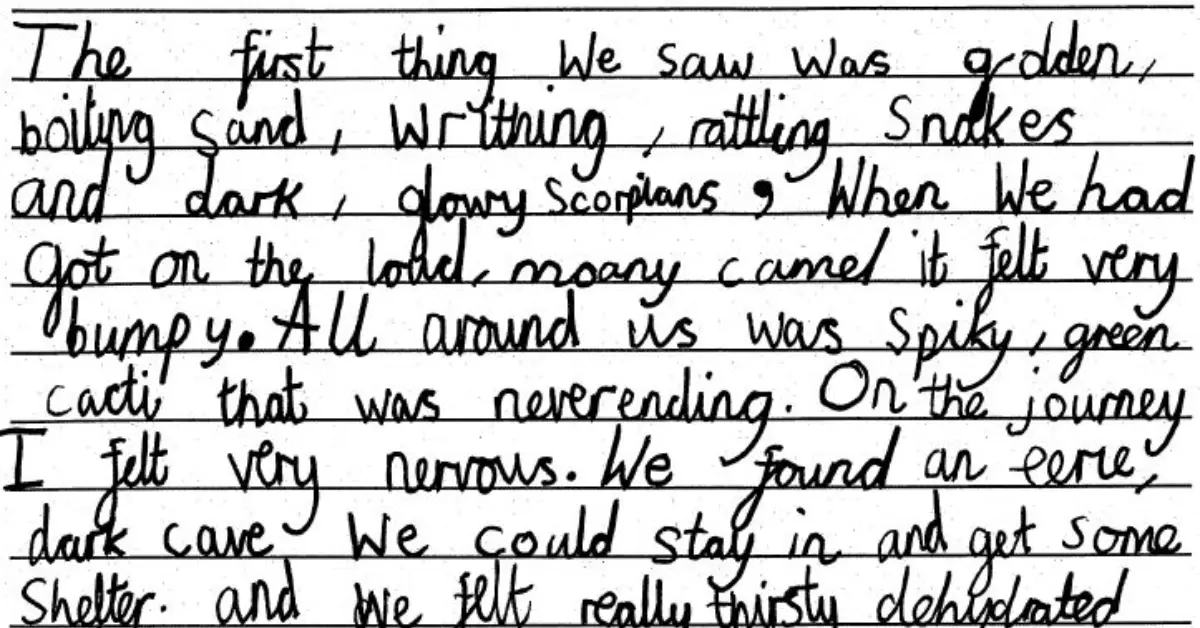
Year 2 handwriting — letters formed correctly and consistently, sitting on the baseline, with proportional spacing between words.
Letter Families — How Schools Teach Formation Groups
One of the most important things to understand about how handwriting is taught in KS1 is that schools don't teach letters in alphabetical order. They teach them in families — groups of letters that share the same starting position and basic stroke movements. This is more efficient because the child practices one movement repeatedly through multiple letters, building the muscle memory for that stroke shape before moving on.
Different handwriting schemes use slightly different groupings, but the letter families used across most UK primary schools look broadly like this:
| Family Name | Letters | Shared Stroke | Taught Roughly |
|---|---|---|---|
| Ladder letters | l, i, u, y, j, t | Straight downward stroke from top | Early Year 1 |
| Curly caterpillar letters | c, a, d, o, g, q, e, s, f | Anti-clockwise curve starting at "2 o'clock" | Year 1, mid-term |
| One-armed robot letters | r, n, m, h, b, p, k | Down, back up, and arch (or bump) | Year 1, mid to late |
| Zigzag letters | v, w, x, z | Diagonal strokes | Year 1, later in year |
| Capital letters | A–Z (all) | Taught alongside lower-case partners | Throughout Year 1–2 |
Why does this matter to parents? Because when you're helping at home, you can reinforce the stroke logic behind letters rather than just whether the end result looks right. Saying "remember — that letter starts with a little c shape" is more useful than "that letter's wrong, try again" — because it gives the child a process to follow, not just a standard to hit.
"b" and "d" are not in the same letter family, but they are mirror images of each other — and mirror image confusion is developmentally completely normal in children up to around age seven. Many schools teach a specific memory trick: "bed" — where the letters b-e-d spell the word and the b and d look like the headboard and footboard of a bed. It's a simple, effective anchor that many Year 1 and Year 2 children find genuinely useful.
Grip, Posture, and Paper Position in KS1
The National Curriculum explicitly includes sitting position and pencil hold as statutory requirements. This isn't just educational pedantry — grip and posture genuinely affect the quality and sustainability of handwriting, and habits formed in KS1 are extremely hard to change later. If your child establishes a workable, relaxed grip now, it will serve them through a decade of schooling. If they develop a tense, awkward grip that gets reinforced through thousands of hours of practice, fixing it as a teenager or adult is a significant undertaking.
The Standard KS1 Pencil Grip
Most UK primary schools teach the dynamic tripod grip: the pencil is held between the tip of the thumb and the side of the index finger, resting on the middle finger, approximately 2–3 centimetres from the tip. The grip should be relaxed — gentle enough that the pencil could be removed with a light pull. The wrist and forearm should rest on the table.
Some children naturally develop a quadrupod grip (four fingers on the pencil rather than three). This is considered acceptable if it is comfortable, produces legible writing, and doesn't cause fatigue. It's not the taught standard, but it's not something that needs correcting if it's functioning well.
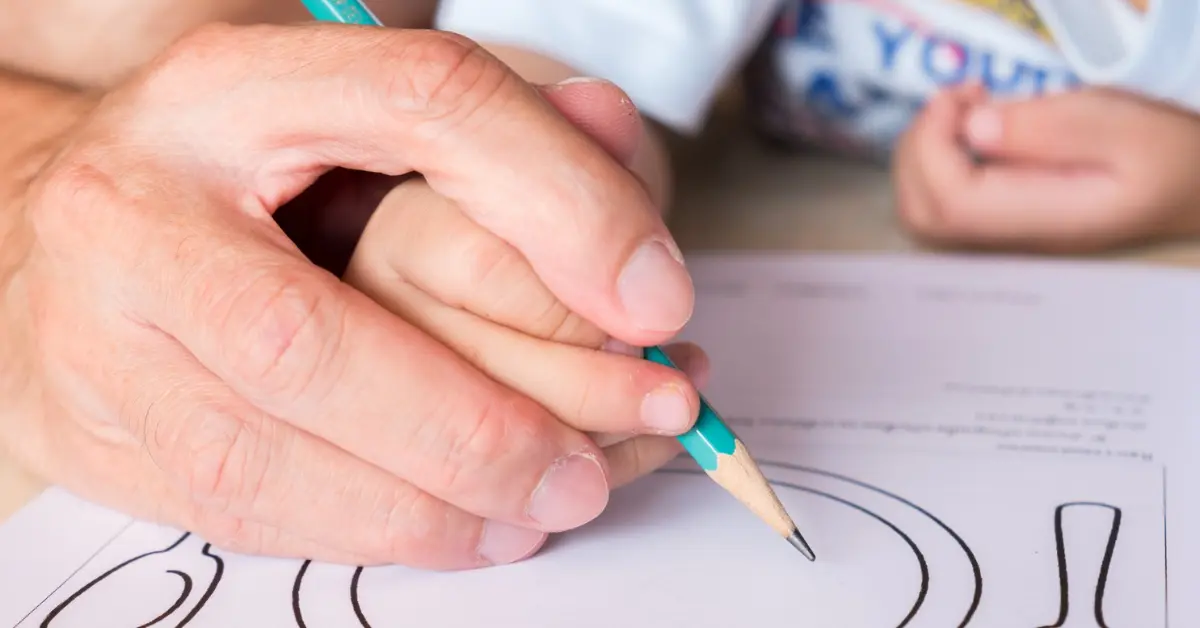
The tripod grip is the standard taught in UK primary schools — thumb, index finger, and middle finger, held lightly about 2cm from the tip.
Sitting Position and Paper Angle
Children should sit with both feet flat on the floor, their non-writing hand flat on the paper to hold it steady, and their writing arm resting on the table from the elbow down. The paper should be tilted slightly — to the left for right-handed writers, to the right for left-handed writers. This tilt is not arbitrary: it aligns the direction of natural hand movement with the direction of the writing, making letter formation easier and reducing arm fatigue.
Left-handed children have specific needs that right-handed teaching doesn't account for by default. Their paper should tilt to the right. Their pencil grip position should be slightly further from the tip to avoid smudging. And crucially, they should never be sat on the right end of a double desk — the elbows will clash. If your child is left-handed, check with their teacher that they're receiving left-handed specific guidance; many class teachers are right-handed and haven't been trained on this specifically.
UK Handwriting Schemes — Which One Does Your School Use?
This is genuinely important for home support, and it's something a lot of parents don't think to ask about. UK primary schools use commercial handwriting schemes — structured programmes with their own letter formation models, progression frameworks, and materials. The formation of some letters differs between schemes. If you teach your child to form a letter one way at home, and their school uses a different starting point or stroke sequence, you create confusion that actively hinders their progress.
Here are the most widely used handwriting schemes in UK primary schools as of 2026:
What to do: Email your child's teacher or check the school's handwriting policy (often available on the school website). Ask which scheme they follow, and if possible, ask for a copy of the letter formation guide they use. Then use the same model at home. It takes two minutes to ask and saves a significant amount of confusion for your child.
Common Parent Concerns — What's a Red Flag and What Isn't
Parents bring a lot of concerns about their KS1 children's handwriting — sometimes well-founded, often not. Here is a plain, honest guide to the most common ones.
Usually not a red flag. Mirror-image confusion is developmentally normal for children up to around age 7–7.5. The brain is still developing the spatial processing needed to distinguish mirror-image shapes reliably. If this is still happening consistently across multiple letters at the end of Year 2, mention it to the teacher — but in Year 1, it's a normal and expected feature of development, not a sign of dyslexia or a processing problem.
Normal in Year 1, something to work on in Year 2. Inconsistent letter sizing is one of the most universal features of early KS1 handwriting. The motor memory for maintaining consistent height simply hasn't been built yet. By the end of Year 2, this should be improving noticeably — but a Year 1 child with inconsistently sized letters is doing exactly what you'd expect.
Worth addressing, but not a red flag for any underlying condition. A very tight pencil grip is extremely common in KS1 and is usually the result of trying too hard rather than a physical difficulty. It often causes hand fatigue after short writing sessions. Gently encourage a lighter hold — "pretend the pencil is a little bird that needs to be held gently but not squashed" is a cue many teachers use. If it's causing pain or significant fatigue, mention it to the teacher.
Not a red flag — but a normal and natural comparison to make. Handwriting development varies enormously at KS1. Fine motor skill development is not uniform. Children who have done more drawing, craft, and mark-making before school often start with a visible advantage. Children who are more physically active or who have had fewer fine motor opportunities at home may start further back. Both groups typically converge significantly by Year 3 when explicit teaching has had more time to take effect.
Possibly worth monitoring, depending on the degree. Some reluctance to write is common in early KS1 — it's hard work and not immediately rewarding. If the avoidance is extreme (refusing entirely, becoming very distressed), it's worth mentioning to the teacher to rule out any difficulty with fine motor control, visual processing, or language that's making writing disproportionately challenging. Mild reluctance is normal; severe avoidance is worth investigating.
Normal in Year 1, something to address in Year 2. Capitals appearing randomly in the middle of words is one of the most common KS1 handwriting issues — usually because a child has learned to write their name starting with a capital and generalises from there. It's a direct teaching issue, not a cognitive one. Consistent reminders and specific practice on lower-case formation for the affected letters usually resolves it during Year 2.
How to Help Your KS1 Child With Handwriting at Home
This is the section most parents are really looking for — and the honest answer is that the bar is lower than most people expect. You don't need to run structured handwriting lessons at home, and trying to do so can actually cause problems if your approach conflicts with the school's. What works is small, regular, positive practice that reinforces what the school is already doing.
The Most Effective Home Strategies, in Order of Impact
What NOT to Do at Home
Don't push joining in KS1. If the school isn't teaching it yet, pushing joins at home creates confusion and often produces worse handwriting, not better. Don't correct every letter during free writing. When a child is composing a story or a card, the cognitive load is already high. Stopping to correct letter formation mid-composition breaks the creative process and often makes children reluctant to write. Save formation corrections for dedicated practice time. Don't compare your child to their siblings or classmates — KS1 development varies enormously, and comparison almost always reduces motivation rather than increasing it.
Moving Into KS2 — What Changes Next?
If your child is at the end of Year 2 and their handwriting is broadly meeting the expectations above, they're in a strong position to move into KS2. The transition from KS1 to KS2 in handwriting is significant — and it's worth understanding what's coming so you can continue supporting them through it.
In Years 3 and 4 (Lower KS2), the focus shifts to joined handwriting. The National Curriculum requires that by the end of Year 4, children write with a joined style. This is a significant shift — not just aesthetically, but physically. Joining letters requires a different motor pattern from printing, and children who have solid KS1 foundations make the transition considerably more easily than those who haven't.
| Stage | Years | Handwriting Focus | Key Goal |
|---|---|---|---|
| EYFS | Reception | Mark-making, pre-writing shapes, pencil hold | Physical readiness for writing |
| Lower KS1 | Year 1 | Letter formation families, baseline, spacing emerging | Correct formation of all letters beginning |
| Upper KS1 | Year 2 | Consistent formation, spacing, pre-joining strokes | Legible, consistent handwriting in all contexts |
| Lower KS2 | Years 3–4 | Introducing and developing joined writing | Consistent joined style by end of Year 4 |
| Upper KS2 | Years 5–6 | Speed, fluency, developing personal style | Fast, legible, consistent joined handwriting |
If your child leaves Year 2 with shaky or inconsistent letter formation, they will likely struggle with the joining work in Year 3 — because you can't join letters you haven't fully mastered in isolation first. This is why Year 2 matters so much: it's not just a year in itself, it's the foundation for the much more complex handwriting work that comes next.
It isn't neat handwriting — it's automatic handwriting. A child who can form their letters without thinking about it is a child whose working memory is free to think about what they're writing, not how they're writing it. In KS2, the writing demands ramp up enormously. The children who thrive are the ones for whom the physical act of writing has become effortless enough that the mental energy can go into ideas, vocabulary, and structure.
✅ Key Takeaways — KS1 Handwriting Expectations
- KS1 covers Year 1 and Year 2 only — Reception is EYFS, not KS1. Expectations are different.
- By end of Year 1: letters being formed in the right direction, some spacing emerging. Consistency is not yet the expectation.
- By end of Year 2: all lower-case letters correctly and consistently formed, correct capitals, consistent spacing, legibility for any adult reader.
- Joining is NOT a KS1 expectation. It is a KS2 objective. Don't push it in Year 1 or Year 2.
- Letter reversals (especially b/d) are normal in Year 1 and can persist into early Year 2. They're only a concern if they continue consistently across multiple letters at the end of Year 2.
- Ask your child's school which handwriting scheme they use — then use the same letter formation at home.
- Five minutes of daily practice, done calmly and positively, produces better results than longer occasional sessions done under pressure.
✍️ Practise KS1 Handwriting on Handwriting Repeater →