Here's the thing nobody in primary education likes to say out loud: for most children, handwriting practice is boring. It's a row of "a"s, a row of "b"s, a worksheet that looks identical to last week's worksheet, and a mild sense of dread every time the pencil box comes out. Teachers know this. Parents know this. The children definitely know this.
The good news is that this boredom isn't inevitable. It's actually a design problem — one that has a very practical solution.
When children are playing a game, they don't notice that they're practising. They're focused on winning, on the rules, on what happens next — and the handwriting is just the thing they do to participate. That's the entire secret of good handwriting games: the game is real, the writing is the mechanism, and the practice happens as a side effect of having fun.
This guide is for teachers who want something that actually works in a classroom setting, and for parents who've run out of ways to convince a reluctant seven-year-old that writing "cat" fifteen more times is a good idea. Every game and activity here has been selected because it genuinely engages primary-age children — not because it looks good on a resource list.
We've also organised everything by setting, age band, and preparation time, so you can find what you need quickly rather than wading through activities that don't fit your situation.
- Why Games Work Better Than Worksheets for Handwriting
- A Quick Age-by-Age Guide: What to Focus on and When
- Section 1 — Classroom Handwriting Games (No Prep Needed)
- Section 2 — Group and Partner Games for Pairs or Small Teams
- Section 3 — Home Handwriting Activities for Parents
- Section 4 — Outdoor and Sensory Handwriting Activities
- Section 5 — Digital Tools That Actually Help
- A Simple Weekly Handwriting Game Plan for Home and School
- Mistakes That Undo All the Progress
- Frequently Asked Questions
Why Games Work Better Than Worksheets for Handwriting
Before we get to the games themselves, it's worth understanding why they work — because it changes how you run them. Handwriting is a motor skill, and motor skills are built through repetition. That part most people know. What's less well understood is that the emotional state during practice affects how well those repetitions stick.
When a child is anxious, bored, or resistant — the classic worksheet experience — the motor pathways formed during practice are associated with those negative emotions. The skill is technically being practised, but the brain is also learning to associate that skill with avoidance. That's why some children's handwriting actually gets worse over time despite regular practice: they're learning, but they're learning the wrong thing.
When a child is engaged, excited, or competitive — the classic game experience — something different happens. The brain releases dopamine, attention sharpens, and the motor patterns formed in that session encode more durably. The same twenty minutes of practice produces genuinely better results when the child is having fun than when they're not.
This isn't a theory. It's well-documented in motor learning research, and it's something experienced teachers discover independently: the child who "hates handwriting" often produces their neatest work when it's embedded in something they actually care about.
Children write more carefully when the writing has a real purpose — a letter that will actually be posted, a menu that will be used in play, a caption for a drawing they're proud of. If you can give handwriting a genuine audience (a grandparent, a friend, the classroom display board), the quality of effort goes up immediately and without any instruction from you. Purpose is the most powerful handwriting motivator for primary-age children, and it costs nothing.
A Quick Age-by-Age Guide: What to Focus on and When
Not every game works for every age. A competitive sentence relay works beautifully with Year 3 children and falls apart completely with Year 1 children who haven't fully automated their letter formation yet. Here's a quick reference for what to prioritise at each stage — and which games map to each one.
The National Curriculum in England expects children to form all lower-case letters correctly by the end of Year 1, begin joining letters in Year 2, and use legible, joined handwriting consistently by Year 4. If you're choosing games for a specific year group, use these benchmarks to decide what skill the game should be reinforcing — and check out our guide on KS1 handwriting expectations for a deeper breakdown of what's expected year by year.
Section 1 — Classroom Handwriting Games (No Prep Needed)
These are the games that work on a Tuesday afternoon when you have fifteen minutes, no photocopying budget, and twenty-eight children who'd rather be doing literally anything else. They require nothing more than pencils and paper — and a few of them don't even need that.
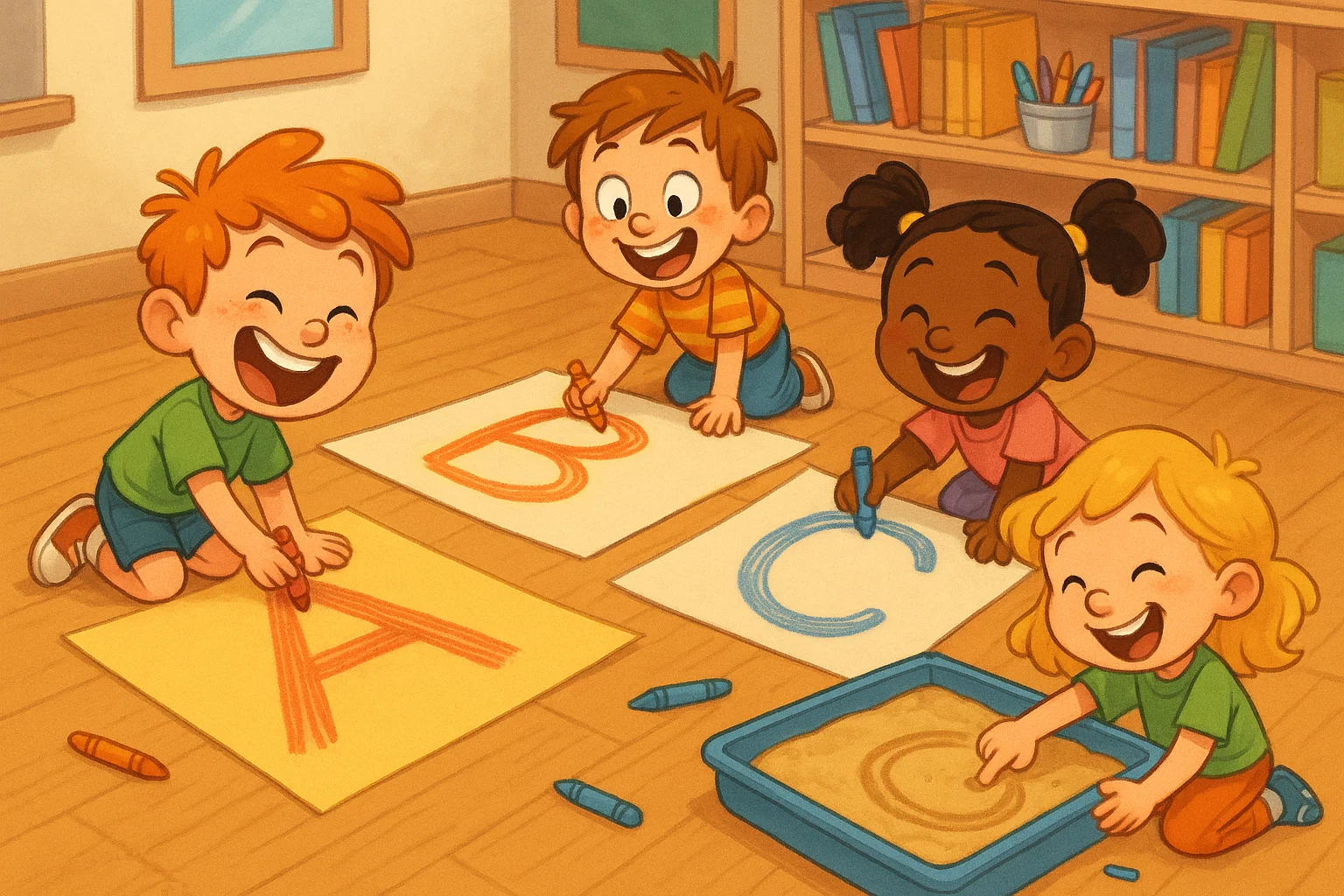
The best classroom handwriting games are the ones that require nothing more than what's already on the desk.
Give each child a 3×3 grid. They choose any 9 letters from the alphabet and write one in each box — as neatly as they can, because that's "part of the game." Call out letters randomly. First to get a row wins. The catch: you check the grid, and letters that aren't formed correctly don't count. Children become remarkably careful about their letter formation when something is at stake.
Why it works: The competition naturally motivates neatness without the teacher ever saying "write more carefully." You're outsourcing the motivation to the game itself.
Call out a letter. Children write it in the air using their whole arm — big, exaggerated movements. Then they write it on their paper. Then they write it in their smallest handwriting. Three sizes, three repetitions, and a race to see who finishes all three versions neatest. The transition from large motor movement to small is genuinely beneficial for letter formation, not just a trick.
Why it works: Large motor movements activate the same neural pathways as fine motor writing. Children who struggle with pencil control often improve faster when they practise the same letter shapes in multiple sizes and modalities.
Write a sentence on the board. Every child copies it once. You (or a teaching assistant) walk around and select the single neatest version in the room. That child reads their sentence aloud and explains one thing they focused on to make it neat. Repeat with a new sentence.
Why it works: Children learn from each other's strategies. When a peer says "I made sure all my tall letters were the same height," that registers differently than when a teacher says it. The selection process also means children try harder on each repetition rather than assuming the first attempt is good enough.
The class writes in complete silence — but each child whispers the stroke sequence of each letter as they write it. "Down, up, over, down" for an "n." "Round, up, down" for a "d." This forces children to be conscious of letter construction rather than producing letters on autopilot, which is where most formation errors live.
Why it works: Vocalising stroke sequences while writing is a proven technique in occupational therapy for improving letter formation in children with motor difficulties. It works just as well for children without difficulties — it just looks a bit odd from the outside.
Write six story starter prompts on the board — "The dragon woke up and discovered..." / "One morning, the library books started moving..." — and let children choose one. They have 10 minutes to write as much of the story as they can, as neatly as they can, because at the end, a random child's book will be read aloud by you. The audience element creates purpose. The story element creates engagement. The writing happens naturally.
Why it works: When children are genuinely invested in what they're writing about, they sustain effort for longer and resist less. Story Starter Cards produce some of the longest voluntary handwriting sessions you'll ever see in a primary classroom.
Section 2 — Group and Partner Games for Pairs or Small Teams
These games work for pairs, table groups, or small teams. They add a social element that the solo worksheet completely lacks — and children who would never voluntarily practise handwriting will often write enthusiastically when there's a teammate waiting on them.
Teams of 4. Write a sentence on the board with one word per child. Each child writes their assigned word as neatly and quickly as possible, then passes to the next. The finished sentences are compared side by side. The winning team is the one whose sentence looks most consistent — not just fast. This specifically targets word spacing and letter sizing consistency across different handwriting styles.
Why it works: The "passing" element creates genuine urgency, and comparing finished sentences teaches children to notice what consistent handwriting looks like — a skill they can then apply to their own work.
One child uses their finger to write a letter or word on their partner's back. The partner guesses what it is, then writes it on paper from memory. Partners swap. This is a tactile game — it reinforces letter shapes through a completely different sensory channel, which is particularly valuable for children who struggle with visual-only approaches.
Why it works: Research on multi-sensory learning suggests that combining tactile, kinaesthetic, and visual input for the same skill significantly improves retention. Back Writing accesses all three channels simultaneously in a way that children find genuinely mysterious and fun.
A standard Snakes and Ladders grid (easy to draw once, photocopy many times) with a twist: to advance, you write the word on each square you land on before rolling again. Land on a word with your target letter? You have to write it three times. You can differentiate this effortlessly — some children focus on letter formation, others on joins, others on speed.
Why it works: The variable repetition produced by the dice roll means children practise different words at different frequencies — which is actually more effective than practising the same word the same number of times, because it prevents children from switching off after the first two repetitions.
Partner A writes a sentence at their normal speed without showing Partner B. Partner B writes the same sentence simultaneously, trying to match Partner A's letter sizing, spacing, and slant. Then they compare. Who produced more consistent spacing? Whose letters hit the line more reliably? This trains children to observe and analyse handwriting quality — a metacognitive skill that dramatically accelerates self-correction.
Each child writes a word. The next child must write a word that starts with the last letter of the previous word — but their word must also contain the letter you've designated as today's focus letter. The chain continues until someone can't think of a word. It's Hangman meets a handwriting drill, and children are so focused on the word puzzle that the writing is almost unconscious.
Before starting any group game, name the one thing you want children to focus on: "Today, I'm looking at word spacing specifically — I want to see a gap between every word that's roughly the width of your finger." Children can hold one focus in mind easily. Three focuses produces zero improvement in any of them. Pick one, stick to it, and notice it in the review at the end. This also makes your feedback far more actionable.
Section 3 — Home Handwriting Activities for Parents
If you're a parent reading this, you've probably been in this position: school has asked you to do "handwriting practice" at home, you've sat your child down with a pencil, and within four minutes there are tears and nobody is having a good time. The worksheet approach works poorly in a school classroom. It works almost not at all at home, where there's no social pressure and a child can simply refuse.
The following activities work because they don't look like homework. They're embedded in things children already want to do — or at least find genuinely purposeful.
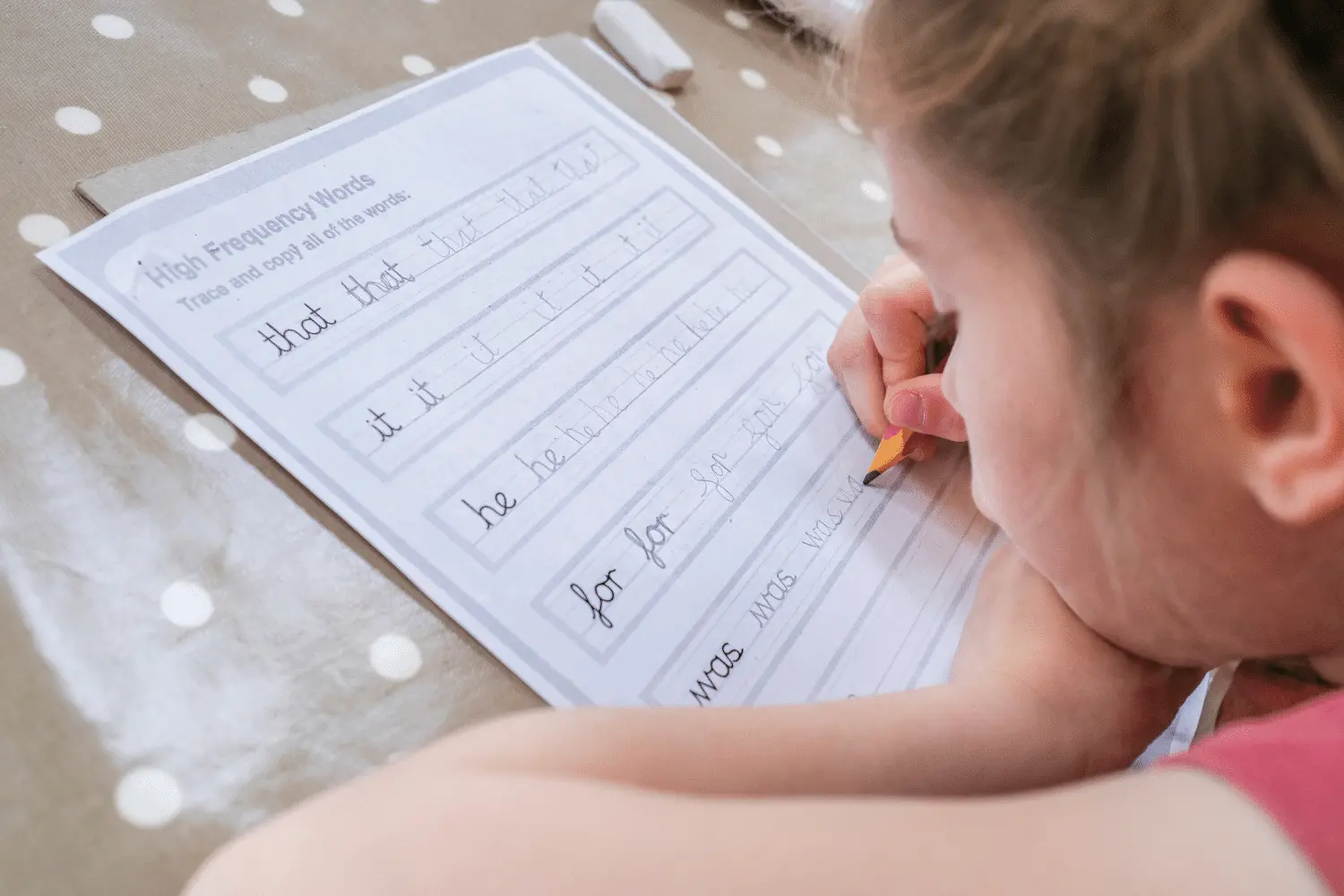
The most effective home handwriting activities are the ones that have a real-world purpose — like a postcard that will actually be posted.
Buy a pack of blank postcards. Your child writes a real postcard to a grandparent, cousin, or friend — ideally someone who will write back. The audience is real. The postcard will actually be posted. Children write more carefully, more slowly, and with more genuine effort on a postcard than on ten pages of practice sheets — because it matters. Receiving a reply makes them want to write another one.
For guidance on what children should be writing at each age, the KS1 handwriting expectations guide gives a clear breakdown of age-appropriate targets.
Your child is in charge of the shopping list this week. You dictate. They write. They must write clearly enough that you can read it in the supermarket — because you'll genuinely use it. If you can't read something, it goes back for a rewrite. This is handwriting practice disguised as responsibility, and children take responsibility very seriously. You can scale the difficulty: Reception children manage three items, Year 4 children manage ten with categories.
Your child designs the menu for a pretend restaurant (or real weekend dinner). They must write out every dish clearly, with a brief description and a price. The menu gets displayed on the dinner table and everyone orders from it. This takes about fifteen minutes of handwriting time and feels like creative play from start to finish. Bonus: children who play this game are also practising the kind of purposeful, public writing they'll do throughout their school career.
Give your child an old newspaper or magazine and ask them to find ten examples of a specific letter — say, the letter "g." They circle each one. Then they practise writing "g" five times, trying to match the printed version as closely as possible. The search element makes it feel like a puzzle rather than a drill, and the comparison to print gives children a concrete model to aim for.
You write a short secret message to your child in your best handwriting. They must read it and write a reply — in their neatest handwriting — within five minutes. The messages can be about anything: a question, a joke, a compliment, a mini quiz. The excitement of receiving a message generates motivation that outlasts any reward sticker chart. This game also models good adult handwriting, which matters more than most parents realise.
Five to ten focused minutes every day is genuinely more effective than thirty minutes once a week. For primary-age children, motor skills are built through distributed practice — small, regular repetitions spread over time, rather than large amounts in a single sitting. If the only home practice you can manage is a grocery list once a day, that's enough to make a real difference. Consistency matters far more than duration. For more on building an effective practice habit, our guide on how to teach handwriting to kids in a stress-free way covers the structure in detail.
Section 4 — Outdoor and Sensory Handwriting Activities
This section is particularly relevant for Reception and Year 1 children, and for any child who struggles with standard pencil-and-paper activities. Sensory activities build the same neural pathways as pencil writing — they just do it through different inputs, which is exactly what children whose hands aren't yet ready for sustained pencil work need.
A tray with a thin layer of fine sand (or salt, or coloured rice). Children trace letters with their index finger, following the same stroke sequence they'd use with a pencil. The sand provides tactile resistance and immediate visual feedback — you can see the letter clearly, and wiping it smooth for the next attempt is genuinely satisfying. This is one of the most recommended pre-writing activities in occupational therapy for a reason: it works.
Take chalk outside. Children write letters and words on the playground surface as large as their whole body. Then medium-sized. Then as small as they can make it still legible. The physical scale change — writing letters half a metre tall — builds the gross motor control that underlies fine motor handwriting far more effectively than any indoor exercise. It's also the most enthusiastically received handwriting activity you'll ever try.
Children roll playdough into thin sausages and form letter shapes with them. This is a pre-writing activity that directly maps to pencil stroke sequences — forming a "d" in playdough requires exactly the same spatial understanding as writing a "d" with a pencil. It's also significantly less threatening for children who experience handwriting anxiety, because playdough can always be reshaped without the permanence of pencil on paper.
Finger paint on a large sheet of paper, forming letter shapes with the whole hand and then individual fingers. This bridges mark-making and letter formation in a way that feels entirely like art. Children who resist pencil work almost never resist paint. Use this as the bridge activity before reintroducing pencil work for reluctant writers — the muscle memory carries across.
A paintbrush dipped in water and used to write letters on a brick wall or paved surface outdoors. Letters appear briefly, then disappear as the water evaporates — which means children can write the same surface again immediately, endlessly, without wasting paper. The impermanence is liberating for children who are afraid of making mistakes on paper. The brush also develops grip strength and stroke control in a completely non-threatening way.
Section 5 — Digital Tools That Actually Help
Digital tools are a genuinely complicated topic in primary handwriting education. Screen time is often discussed in opposition to handwriting — and for good reason. If a child is using a tablet instead of writing, that's a problem. But if a digital tool is being used as a scaffold or motivator that leads to more physical writing, it can be genuinely valuable.
The distinction matters a lot. A child who uses a digital tool to decide what they'll practise today, then picks up a pencil to actually practise it, is using technology in a way that supports handwriting development. A child who traces letters on a screen with their finger and never picks up a pencil is not making any progress on the actual skill.
Handwriting Repeater: The Tool Built for This
Our own tool, Handwriting Repeater, is designed specifically to bridge the gap between digital engagement and physical practice. Here's how it works in practice: a child (or teacher, or parent) types in a sentence, word, or letter combination they want to practise. The tool displays it in a structured, repeating format — the same word or sentence shown multiple times with practice lines — and the child writes it out with a real pencil on real paper.
The digital element is simply the generator of the practice material. The actual practice is entirely analogue. This makes it more flexible than any pre-printed worksheet (you can practise anything, instantly, tailored to a specific child's weaknesses) while keeping the physical handwriting where it belongs: on paper, with a pencil, training real motor memory.
It's particularly useful for the home context. Parents who aren't sure what sentences to use for practice can generate them instantly. Children who want to practise their own name, a specific word they find difficult, or the sentences from this week's homework can do so without waiting for a worksheet.
| Tool Type | Best For | Limitation | Verdict |
|---|---|---|---|
| Handwriting Repeater | Generating personalised practice material instantly; home practice | Still requires pencil and paper for the actual writing | ✅ Highly recommended as a scaffold |
| Tracing apps (touchscreen) | Pre-writing pattern recognition for very young children | Finger on screen doesn't translate to pencil control | ⚠️ Only for Reception as a supplementary activity |
| Word processor | Composition — getting ideas down without the barrier of handwriting | No handwriting practice whatsoever | ❌ Not a substitute for pencil practice |
| Stylus on tablet | Children who can't physically use a pencil; accessibility | Different muscle requirements to pencil; not a direct substitute | ⚠️ Use for accessibility, not for mainstream practice |
A Simple Weekly Handwriting Game Plan for Home and School
One of the most useful things you can take from this guide is a repeatable structure that doesn't require you to reinvent the wheel every session. Here's a weekly plan that works for both classroom and home settings. Each session is 10–15 minutes. The variety across the week prevents repetition fatigue while ensuring every key element gets covered.
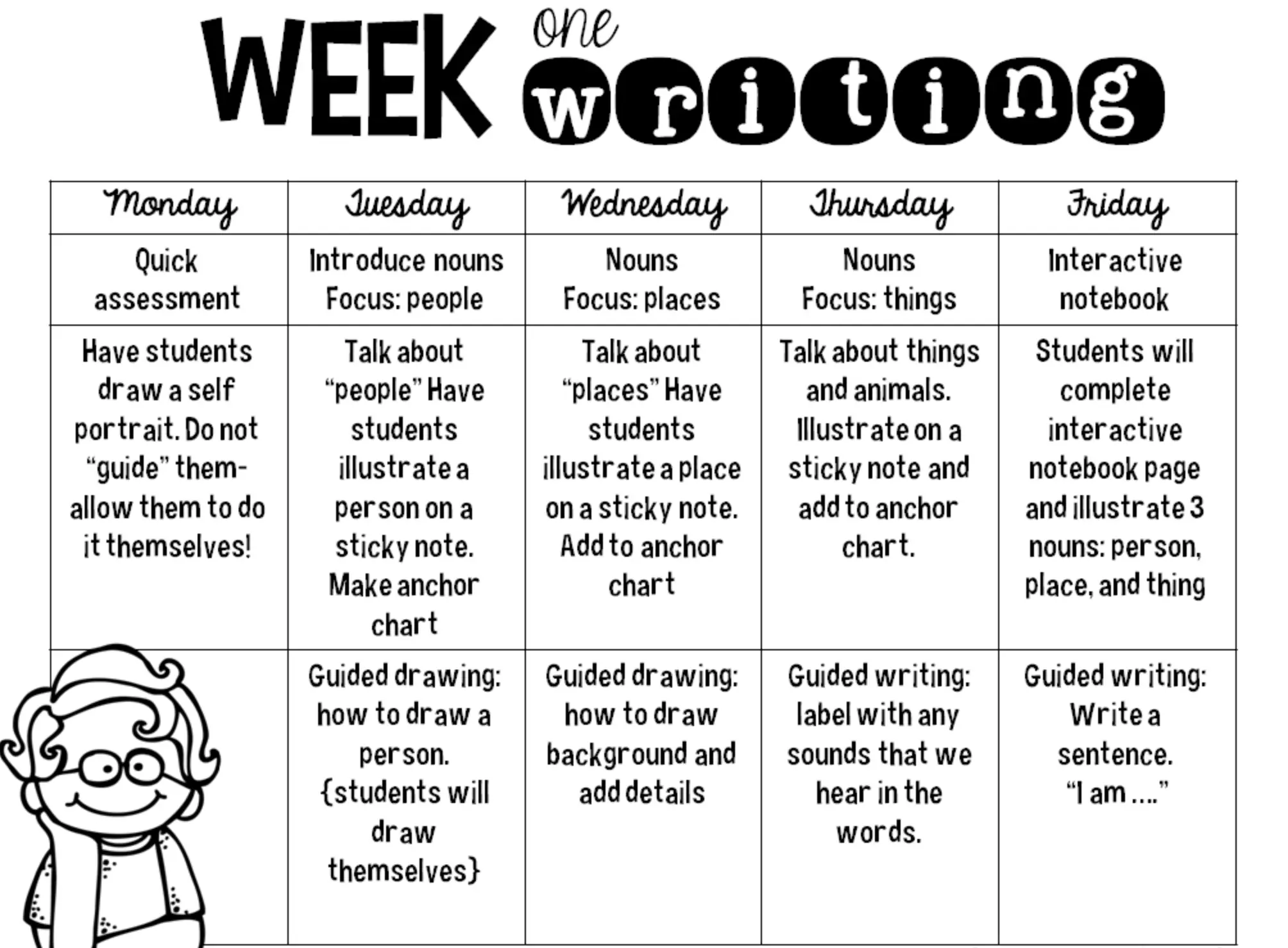
A structured weekly plan — even a very simple one — produces dramatically better results than random, unstructured practice sessions.
Mistakes That Undo All the Progress
Even with the best games and the most motivated children, a few reliable mistakes will slow or reverse progress. These are the ones worth knowing about before you start — because they're all very easy to make, and not always obvious.
During game sessions, the competitive element naturally pulls children toward speed. If you praise the child who finishes first without checking their letter formation, you've just trained the whole class to write faster and sloppier. Be explicit before every game: "I'm looking for neat first, fast second. The winner is the one who's both — but if I have to choose, I choose neat." Then actually enforce it.
Most children with poor handwriting quality are gripping their pencil far too tightly. Games don't fix this automatically — you have to specifically address it. Before any game session, remind children of the tripod grip and demonstrate a light hold. Tell them if they notice their hand aching, that's the signal to relax. You'll need to say this every session for about three weeks before it starts to become habit. It's worth the effort.
The biggest mistake teachers and parents make with handwriting games is using them occasionally as a special activity while maintaining the worksheet-as-default approach. Games work because they change the emotional context of handwriting practice — but that only produces lasting results if the changed context is consistent. If children spend four days a week on worksheets and one day on games, the worksheet anxiety remains the baseline. Flip the ratio. Make the games the default, and the worksheet the occasional change of pace.
Handwriting games are the practice. The review is where the learning is consolidated. After any game session, spend two minutes comparing work from the start of the session to the end. What improved? What needs more attention next time? Children who review their own work start to develop an internal quality standard — they know what "good" looks like and notice when they've achieved it. That self-assessment ability is ultimately what produces children who maintain good handwriting independently.
A child who's slumped in their chair with a death grip on their pencil and paper at an awkward angle will not produce good handwriting regardless of how engaging the game is. Physical setup matters enormously — and it takes about thirty seconds to check and correct before a session. Feet flat. Forearm on the desk. Paper tilted slightly. Pencil held loosely. If these four things are right, the game does the rest.
Most children's handwriting improves significantly with consistent game-based practice. But some children have underlying difficulties — dyspraxia, dyslexia, hypermobility, or fine motor delays — that require specialist input beyond what games can address. Signs to watch for: persistent letter reversals past Year 2, extreme pencil grip that causes visible pain or fatigue after minimal writing, letter formation that doesn't improve despite months of consistent practice, and significant distress around any writing task. If you're seeing these, speak to your SENCO (in school) or your GP (at home). Our guide on helping a child with dyslexia improve their handwriting covers specific strategies for children with additional needs.
✅ Key Takeaways — Handwriting Practice Games for Primary School Children
- Games work better than worksheets because they change the emotional context of practice — and that emotional context directly affects how well motor skills encode.
- The best games have a real competitive or purposeful element. Children should be focused on winning the game, not on the fact that they're practising handwriting.
- Most no-prep classroom games require only pencils and paper. You don't need special resources to run effective handwriting game sessions.
- Purposeful writing — postcards, grocery lists, menus — produces more careful handwriting than drill-based practice because the audience is real.
- Sensory and outdoor activities (sand trays, chalk, water writing) are particularly valuable for Reception and Year 1 children whose hands aren't ready for sustained pencil work.
- Digital tools like Handwriting Repeater work best as generators of practice material, not as replacements for physical writing.
- Always name one specific focus per session. One thing done well beats three things done poorly, every time.
- Review work at the end of every session. The review is where the learning consolidates.
✍️ Generate Handwriting Practice Material on Handwriting Repeater →
📚 More Guides You Might Find Useful
- How to Teach Handwriting to Kids in a Fun and Stress-Free Way The complete parent and teacher guide to making handwriting genuinely enjoyable — covering everything from grip to motivation.
- How to Help a Child with Dyslexia Improve Their Handwriting Specific, practical strategies for children who face additional barriers to handwriting development.
- 100 Handwriting Practice Sentences for Students and Teachers A ready-made resource of practice sentences for every age and ability level — use them directly in your game sessions.
- How to Improve Your Handwriting — 10 Simple Tips That Actually Work For older children and adults — a practical improvement guide built around what actually changes handwriting.
- KS1 Handwriting Expectations — What Should My Child Write by Year 2? A parent's guide to the National Curriculum handwriting targets for Reception, Year 1, and Year 2.