Pencil Grip for Kids — Why It Matters and How to Fix a Bad Grip
The way a child holds their pencil shapes everything that follows — letter formation, writing speed, legibility, and how long they can write before their hand gives up.
There's a moment most parents and teachers recognise. A child sits down to write, hand curled around the pencil in some arrangement that looks wrong but seems to be working — sort of. The letters are there, if not exactly where you'd want them. The child is writing, technically. So you leave it.
Months later — sometimes years later — the same child is complaining that their hand hurts after writing a paragraph, that they can't keep up with the class, that their handwriting looks worse than everyone else's even though they're trying just as hard. And at some point someone — a teacher, an occupational therapist, a parent who finally googled it — looks at the pencil grip and says: that's where it's coming from.
This is one of those topics where a small thing — literally just how you hold a pencil — has consequences that ripple through years of schooling. And unlike many handwriting problems, pencil grip is something you can actually do something about, especially if you catch it early.
This guide covers everything honestly: what a good grip actually looks like, what the common bad ones look like and why they form, how occupational therapists approach correction, and what you can do right now at home or in the classroom. No fluff, no panic — just practical, research-grounded information that actually helps.
- What the Correct Pencil Grip Actually Looks Like
- How Pencil Grip Develops — The Natural Stages
- The Most Common Bad Grips — and Why They Form
- Why Pencil Grip Actually Matters for Learning
- How to Correct a Bad Grip — Step by Step
- Fine Motor Exercises That Support a Better Grip
- Pencil Grip Aids — Which Ones Actually Work
- Left-Handed Children — What's Different and What to Do
- Common Myths About Pencil Grip
- Frequently Asked Questions
What the Correct Pencil Grip Actually Looks Like
Before we can talk about fixing bad grips, it helps to have a clear picture of what a good one actually is. There are a handful of grips that occupational therapists and handwriting specialists consider functional — meaning they work well, allow controlled movement, and don't cause fatigue or injury. The most widely recommended for children is the dynamic tripod grip.
Here's what it looks like in practice:
-
1The pencil rests on the middle finger
The middle finger acts as a shelf or support. The pencil sits in the groove between the first and second knuckle — not at the very tip, and not back near the base of the finger. This positioning gives control and reduces strain on the index finger.
-
2Thumb and index finger pinch lightly from either side
The pad of the thumb and the side (not the tip) of the index finger make contact with the pencil roughly 1–2 cm from the tip. The contact should be relaxed — not a death grip. If the knuckles are white or the fingertips blanch, the child is holding too tightly.
-
3An open "O" or "C" space between thumb and index finger
This is the clearest visual check: there should be a visible gap — sometimes called the "web space" — between the thumb and index finger. If this space is collapsed flat, the grip is too tight and restricts movement. The web space allows the small, efficient finger movements that produce good letter formation.
-
4Ring and little fingers curl inward
These two fingers aren't passive — they provide the stable "tripod" base that the writing fingers work from. They should rest lightly on the paper or curl toward the palm. If they're extended out to the side or pressing flat on the paper, the grip loses its stability.
-
5Pencil angles back over the shoulder at about 45°
The pencil should lean back toward the writing shoulder, not point straight up toward the ceiling or lie almost flat on the page. The angle varies slightly by individual, but roughly 45° is the functional sweet spot. A pencil pointing too vertical usually means the wrist is flexed too far; too horizontal usually means the grip is too far back on the pencil.
Here's the method occupational therapists use with young children: hold the pencil with the tip pointing away from you, pinch it between your thumb and index finger at the very tip, then flip it so it falls back onto your writing hand. It lands in almost exactly the right position. Teach this to any child struggling to find the grip from scratch — it takes about 30 seconds to learn and removes all the awkward repositioning.
A correct pencil grip has three qualities: it's relaxed (not white-knuckled), it leaves an open web space between thumb and index finger, and it allows the fingers to move — not just the wrist or whole arm. Any grip that achieves these three things is functional. The exact finger positions can vary slightly — it's the principles that matter.
How Pencil Grip Develops — The Natural Stages
One thing that trips a lot of parents up: seeing a young child hold a pencil "wrong" and panicking, when actually it's completely appropriate for their age. Pencil grip isn't a single skill — it's a developmental trajectory that unfolds over several years as a child's fine motor skills, hand strength, and coordination mature.
Understanding the stages helps you know what's normal, what's a red flag, and when to step in.
What this means practically: if a 3-year-old is using a fist grip, that's fine. If a 6-year-old starting school is still using a fist grip and can't form letters with any control, that's worth addressing. The developmental clock runs differently for every child, but the transitions above give you a reasonable timeline to work from.
By the time a child starts formal writing instruction — usually around age 5 in the UK and most of Europe — they should be somewhere between static and dynamic tripod grip. A fist grip at this stage is a clear sign that fine motor development needs support, and early intervention will make a significant difference to their handwriting journey. For more on what to expect at school-entry age, our guide on KS1 handwriting expectations covers the full picture.
The Most Common Bad Grips — and Why They Form
Not all non-standard grips are equally problematic. Some are minor inefficiencies that don't significantly affect writing quality; others actively interfere with letter formation and cause pain. Here are the grips that appear most often in classrooms and what's going on with each one.
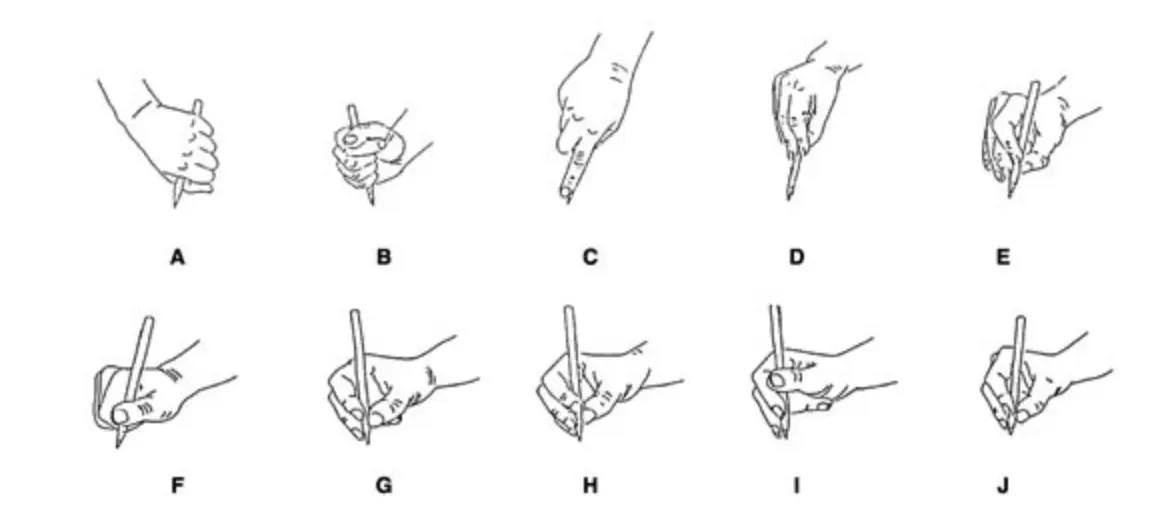
Four common pencil grips — from the functional dynamic tripod to the problematic fist grip. Recognising which one your child uses is the first step.
The thumb wraps over the top of the index finger, collapsing the web space entirely. This is one of the most common grip problems in primary-age children and one of the most disruptive, because it prevents independent finger movement — the whole hand has to move to produce each letter stroke. Children with this grip often write slowly, run out of space on lines, and complain of hand ache after extended writing. Why it forms: usually because the child gripped the pencil tightly at an early stage and the habit never corrected. Low hand strength also makes children default to tighter, less controlled grips.
❌ Problematic — needs correctionThe pencil is held inside the whole fist, with the tip protruding below the little finger. All five fingers wrap around the shaft. This is entirely age-appropriate in toddlers but becomes a significant barrier to writing quality when it persists into school years. Children with a fist grip have almost no fine motor control over letter formation — they write using large arm movements, which is why their letters tend to be big, irregular, and inconsistently spaced. Why it persists: often weak intrinsic hand muscles, low tactile sensitivity, or lack of early fine motor play (threading, bead-work, scissors).
❌ Problematic — OT referral worth consideringSeen almost exclusively in left-handed writers: the wrist curves dramatically above the pencil, with the hand hooking so the fingers point downward toward the writer. Many left-handed adults write this way without realising there's an alternative. It develops when left-handed children are taught right-handed paper positioning — they compensate by rotating their wrist to avoid smearing what they've just written. It usually causes significant wrist and forearm fatigue in long writing sessions. Why it forms: incorrect paper positioning. It's largely preventable with proper setup from the start.
❌ Causes fatigue and discomfort long-termThe index finger points straight down along the top of the pencil rather than pinching from the side. This is more of a mild inefficiency than a serious problem — many people write this way throughout their lives with perfectly legible results. It does tend to produce heavier pencil pressure and slightly less fluency than the tripod grip, but in mild cases it's not worth the disruption of correction. When to address it: if combined with excessive pressure, slow writing, or discomfort, a gentle correction is worthwhile. If writing quality is fine and the child is comfortable, leave it.
⚠️ Minor issue — situational correctionFour fingers on the pencil instead of three, with the ring finger adding contact alongside the tripod fingers. This is a transitional grip that some children use as they develop from static to dynamic tripod. In most cases, children phase it out naturally. If it persists, it's worth a gentle nudge toward tucking the ring finger under, but it's rarely as disruptive as the thumb wrap or fist grip.
⚠️ Often self-corrects — monitorWhy Pencil Grip Actually Matters for Learning
People sometimes wonder whether grip correction is worth the battle — after all, plenty of people with unusual grips write legibly enough. That's a fair question, and the honest answer is: it depends on the grip and the child. But here's why it matters more than many parents and teachers appreciate.
A child using an inefficient grip tires significantly faster than a child with a functional one. The muscles involved are working harder, often in positions they're not designed to sustain. By the end of a 40-minute writing session — or an exam — this translates directly to shorter, lower-quality written output. Teachers sometimes interpret this as effort or motivation, when it's actually biomechanics. The child isn't lazy; their hand is genuinely exhausted. Our article on the science behind handwriting covers the cognitive side of this in more depth.
Good letter formation — the consistent, controlled production of recognisable letters — requires small, precise finger movements. An inefficient grip that bypasses finger movement (like the fist grip or thumb wrap) means a child is producing letters with gross arm movement instead. The results are inconsistent letter sizes, poor spacing, variable baseline, and difficulty with letters that require fine directional control (b/d, p/q). These problems don't improve with practice if the grip doesn't change — you can't practise your way to precision using imprecise tools.
GCSE, A-Level, and equivalent written exams require sustained, fast handwriting for extended periods. Students who haven't developed a fluent, efficient grip struggle enormously in these settings. Many end up with exam access arrangements (extra time) not because of any learning difficulty but because their grip slows them down. This is entirely preventable with early intervention. Pair efficient grip with the techniques in our guide to writing neatly and fast and the results compound quickly.
There's a concept in handwriting research called the transcription burden: the cognitive cost of the physical act of writing. When a child has to concentrate on the mechanics of holding the pencil and forming letters, they have less mental bandwidth for the content of what they're writing. Poor grip amplifies this burden significantly. Children with inefficient grips produce shorter, simpler compositions not because they lack ideas or vocabulary, but because managing the physical side of writing uses up most of their working memory. Fix the grip, reduce the burden, free up the thinking.
A large-scale observational study of pencil grips in school-age children found that while a range of grip styles could produce functional writing, children with grips that restricted finger mobility consistently produced lower-quality written output at slower speeds as writing demands increased — effects that became more pronounced rather than less as children progressed through school.
What this means: A grip that "works" in Year 1 may not scale to the demands of Year 6 and beyond. What looks like a minor quirk at age 5 can become a significant barrier at age 10. Early correction pays compounding dividends.
How to Correct a Bad Grip — Step by Step
Here's where most articles either give vague advice ("just remind them to hold it correctly") or overcomplicate things. The reality is that grip correction works — it just needs to be approached strategically. Constant nagging during writing is the least effective method. Here's what actually works.
- Is the pencil in the pinch position — not gripped in the fist?
- Is there an open "O" or "C" gap (web space) between thumb and index finger?
- Is the pencil resting on the middle finger — not gripped by all four fingers?
- Are the ring and little fingers curled inward or resting lightly?
- Is the pencil angled back over the shoulder — not pointing straight up?
- Is the grip relaxed — fingers a normal colour, not whitened from pressure?
If a child is over age 10 and has a grip that produces legible, reasonably fast writing without discomfort, think carefully before pursuing aggressive correction. Re-learning a grip at this age requires conscious attention that disrupts writing quality and can create anxiety around handwriting. Many OTs take a pragmatic view: if the grip works, focus energy elsewhere. Grip correction above age 10 is most clearly worth pursuing when the child has pain, their writing is significantly slower than peers, or they're heading into exam years with a grip that won't scale. For context, our handwriting improvement guide covers the broader picture of improvement at different ages.
Fine Motor Exercises That Support a Better Grip
Here's something that isn't said enough: many pencil grip problems are fundamentally strength and coordination problems, not habit problems. A child whose intrinsic hand muscles (the small muscles inside the hand that control finger movements) are underdeveloped will default to gross grips because they literally don't have the strength or coordination for fine ones yet. The solution isn't more writing — it's targeted play that builds the right muscles.
These activities are most effective when done as play — not prescribed exercises. A child who plays with play-dough for twenty minutes is doing more for their pencil grip than a child who spends the same time copying letters with poor hand strength.
Place three small coins in the child's palm, curled fingers holding them (this is actually the curl position of ring and little fingers during writing). Ask them to pick up a fourth coin from a surface with just their thumb and index finger — without dropping the others. This trains the separation of the two sides of the hand, which is what makes the dynamic tripod grip possible. Start with large coins and progress to smaller ones. Many OTs use this in the first few sessions — it's simple, effective, and children find it surprisingly fun.
Pencil Grip Aids — Which Ones Actually Work
The pencil grip aid market is full of products, and parents often end up buying several before finding something useful — or giving up entirely. Here's an honest breakdown of the main types, what they're good for, and their limitations.
| Grip Aid | How It Helps | Best For | Limitations |
|---|---|---|---|
| Triangular Pencils / Crayons | The three flat sides naturally guide fingers toward the correct positions | Beginners aged 3–5; children with mild grip issues | Less effective for established bad habits; can be harder to find |
| Stetro Grip | Four-sided rubber grip that slots onto any pencil; has grooves for each finger | Children with thumb wrap or index-on-top grips who need physical guidance | Some children find the feel uncomfortable; can become a crutch |
| Crossover Grip | Rubber strap that goes around pencil and over thumb, physically preventing the wrap grip | Persistent thumb wrap grip in ages 6–9 | Targeted at one specific grip problem only; not versatile |
| Jumbo / Thick Pencils | Larger diameter is easier for small hands to grip without over-tightening | Preschool age; children with low hand strength or grip too tight | Needs to transition to standard pencil eventually; doesn't fix position |
| Comfort Grip / Foam Grip | Soft foam sleeve reduces pressure and fatigue during writing | Children who press too hard; hypermobile fingers | Doesn't correct grip position; mainly a comfort aid |
| Pencil Weight Bands | Small weighted sleeve increases proprioceptive feedback (feel of the pencil) | Children with low tactile sensitivity; sensory processing differences | Specialist use; most effective alongside OT guidance |
The goal of any grip aid is to provide external support while the child builds the internal muscle memory and habit of the correct grip. They should be faded out gradually — used consistently for 4–6 weeks, then used only for new writing sessions (not all day), then phased out entirely. A child who still needs a Stetro grip at age 10 hasn't learned the grip — the aid is doing the work for them. Plan a progression from supported to independent from the start. For consistent practice that builds the right habits, Handwriting Repeater lets you control pen size and type — useful for adjusting the digital equivalent of these real-world aids.
Left-Handed Children — What's Different and What to Do
Left-handed children are disproportionately represented among children with grip and handwriting difficulties — not because left-handedness is a disadvantage, but because most handwriting instruction is designed for right-handers, and left-handed children are often taught setups that actively work against them.
Right-handed writers tilt their paper counter-clockwise (top of paper pointing left). Left-handed writers should tilt their paper clockwise (top of page pointing right). This means the left hand is writing below and to the right of the writing — preventing smearing and crucially preventing the wrist hook that develops when left-handers try to see what they've just written using right-handed paper position. Many adults don't learn this until they're adults. Teach it from day one.
Left-handed writers benefit from gripping the pencil slightly further from the tip than right-handers — about 2–3 cm rather than 1–2 cm. This gives them a clearer sightline over the pencil to see what they're writing, without needing to curve the wrist upward to see around their hand. Combined with correct paper tilt, this eliminates most of the visual obstruction problems that drive both hook grips and excessive pressure in left-handed children.
In classrooms, left-handed children should ideally sit to the left of right-handed children to avoid elbow clashes during writing. At a desk, the paper should be positioned to the left of the body midline. Both of these adjustments are easy for teachers to implement and make a surprising difference to left-handed children's writing comfort — yet they're often overlooked. If your left-handed child is struggling with handwriting, ask their teacher about their seating position before assuming there's a grip problem.
Common Myths About Pencil Grip
There's a lot of well-meaning but inaccurate advice floating around about pencil grip. Some of it leads parents and teachers to intervene when they shouldn't, or not intervene when they should. Here are the most common misconceptions.
Who Does What — Quick Reference by Role
Pencil grip matters more than most people realise — and it's also more fixable than most people assume. A few minutes of targeted attention before age 7–8 can prevent years of handwriting difficulties, writing fatigue, and the creeping academic disadvantage that follows from them. The right grip isn't about perfectionism — it's about giving a child a tool that works with their hand rather than against it. Start with the pinch-and-flip, check the web space, build the strength through play, and be consistent. That's genuinely enough.
Frequently Asked Questions About Pencil Grip
What is the correct pencil grip for children?
The most widely recommended grip is the dynamic tripod grip: the pencil is held between the pad of the thumb and the side of the index finger, resting on the middle finger, with the ring and little fingers curled underneath for support. There should be an open "O" shaped gap (web space) between thumb and index finger — if this is collapsed, the grip is too tight. The pencil angles back over the shoulder at roughly 45 degrees. The grip should feel relaxed, not white-knuckled. The lateral tripod (pencil resting on the index finger rather than the middle) is also considered functional by most occupational therapists.
At what age should a child have a correct pencil grip?
The dynamic tripod grip typically emerges naturally between ages 4 and 6 as fine motor skills mature. Before this, a range of immature grips are completely normal — fist grip in toddlers, digital pronate at 3–4 years. By the time a child starts formal school (usually around age 5 in the UK), they should be transitioning toward a functional grip, though not necessarily a perfect one. A fist grip that persists past age 5–6 and into formal writing instruction is worth addressing, as it will limit writing development.
Does pencil grip really affect handwriting quality?
Yes — significantly. A poor pencil grip affects letter formation quality, writing speed, legibility, and causes fatigue far faster than a functional grip. Children with inefficient grips often press too hard (breaking tips, tearing paper), write inconsistently, and complain of hand ache after only a short time writing. Over time, this also affects written output quality: children whose hands tire quickly write shorter, simpler pieces — not because they lack ideas, but because managing the physical side of writing uses up too much of their concentration. Our piece on the science behind handwriting covers the research on "transcription burden" in depth.
Is it too late to correct a pencil grip in older children?
It's never too late, but it gets harder as habits become more ingrained. Correction is easiest before age 7–8. After age 10, most occupational therapists take a pragmatic approach: if the grip produces functional writing without pain, the disruption of retraining may not be worth it. If the grip is causing problems — pain, poor legibility, significantly slower writing than peers — intervention is still worthwhile at any age, just requiring more patience and consistency. For older children and adults, our handwriting improvement guide has relevant strategies.
What grip aids actually help children hold a pencil correctly?
The most commonly recommended aids are triangular pencils (the shape guides fingers naturally), Stetro grips (rubber grips that slot onto standard pencils with grooves for each finger), and the Crossover grip (stops thumb wrapping). Thicker pencils help younger children who over-grip thin ones. The important caveat: grip aids are scaffolding, not solutions. They should be faded out gradually over 4–6 weeks as the child builds the habit independently. A child still using a Stetro grip at age 10 has learned to rely on the aid rather than internalising the correct grip.
My child holds their pencil in their fist — is that a problem?
A fist grip (palmar grasp) is completely normal in toddlers under 3–4. If it persists past age 5 into school years, it's worth addressing — it significantly limits fine motor control and forces the child to write using whole-arm movement instead of finger movement, making consistent letter formation nearly impossible. The solution is a combination of grip correction (using the pinch-and-flip method) and fine motor play activities that build hand strength — play-dough, threading, cutting, climbing. With consistent daily practice, most fist grips can be corrected within 4–6 weeks.
Can a left-handed child use the same pencil grip as a right-handed child?
The grip itself is the same (dynamic tripod, left hand), but the setup needs adjustment. Left-handed children should tilt their paper clockwise (opposite to right-handers), grip the pencil slightly further from the tip to see what they've written, and sit to the left of right-handed classmates. These adjustments prevent the "hook grip" that many left-handed writers develop — not because of any inherent problem with left-handedness, but because they were given right-handed paper positioning and compensated by wrist-hooking to see their work.
What fine motor activities help improve pencil grip strength?
The most effective activities for building grip-supporting hand strength include play-dough squeezing and rolling, cutting with scissors, using tweezers or kitchen tongs to pick up small objects, threading beads or lacing cards, building with small LEGO, finger painting, and physical climbing (monkey bars, rope ladders). These activities build the intrinsic hand muscles — particularly the thenar muscles at the thumb base — that make a relaxed, controlled grip possible. They work best as play, not prescribed exercises, and children will do them far longer and more willingly in a play context.
Should I correct my child's pencil grip while they're writing?
Generally not — interrupting writing to correct grip breaks concentration and can create self-consciousness around handwriting. The better approach is to address grip before the writing session begins (a 30-second check and correction before they put pen to paper), do brief check-ins at natural pauses, and build the habit through dedicated short practice sessions rather than constant corrections during writing. Positive reinforcement when the child uses the correct grip works much better than pointing out when they don't. The goal is to make the correct grip the default through repeated practice, not constant reminding.
When should I see an occupational therapist about my child's pencil grip?
Consider an OT assessment if your child is over age 6 and still using a fist grip; if they report pain or discomfort when writing; if their handwriting is significantly behind peers despite regular practice; if you notice unusual compensatory postures (head tilting, shoulder rising, whole-arm writing movement); or if grip difficulties appear alongside other fine motor challenges like difficulty with buttons, zips, or scissors. For children with dyslexia or other learning differences, our article on helping children with dyslexia improve their handwriting covers the overlap between grip, motor skills, and learning differences.
- How to Teach Handwriting to Kids in a Fun and Stress-Free Way
- The Science Behind Handwriting — Why Writing by Hand Improves Memory
- How to Improve Your Handwriting — 10 Simple Tips That Actually Work
- 20+ Handwriting Practice Games for Primary School Children
- How to Help a Child with Dyslexia Improve Their Handwriting
- Handwriting Practice for Adults — Rebuild Your Handwriting From Scratch
- 100 Handwriting Practice Sentences for Students and Teachers
- How to Write Neatly and Fast — A Step-by-Step Guide for Students